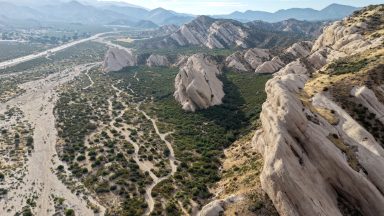
California residents have been hearing about “The Big One” for decades. The term refers to a potentially catastrophic earthquake that will strike one of the state’s major fault systems, particularly the San Andreas Fault and the San Jacinto Fault. While scientists agree that another major earthquake will happen someday, they emphasize that they can’t predict the exact date, time or location.
Recent studies and seismic monitoring have renewed concerns about California’s earthquake risk, especially as stress continues to build along several active fault lines. Here’s what experts know about the state’s next potential “Big One.”
When Was the Last ‘Big One’ Earthquake in California?
That depends on how “The Big One” is defined. For Southern California, experts point to the 1994 Northridge earthquake, which registered a magnitude 6.7, killing 57 people while causing an estimated $20 billion in damage. Although it was devastating, Northridge was smaller than the catastrophic earthquake scenarios often associated with “The Big One.”
Others consider the last true “Big One” as the 1906 San Francisco earthquake. The quake had a magnitude of 7.9 and ruptured a large section of the San Andreas Fault. The earthquake and fires destroyed parts of San Francisco and killed thousands of people.
The other recorded “Big One” occurred in 1857, measuring at a 7.9 magnitude. It ruptured the southern section of the San Andreas Fault, between Parfield and Wrightwood, California.
Scientists are concerned about the southern section of the San Andreas Fault to this day.
When Will the Next Big Earthquake Happen?
As for the next “Big One,” the short answer is that nobody knows when it will happen — but it’s imminent.
According to the U.S. Geological Survey (USGS), earthquakes cannot currently be predicted with enough precision to determine the exact date, time or location when or where the next major quake will occur.
Researchers have, however, developed models that estimate the likelihood of large-scale earthquakes in California. Previous USGS forecasts discovered substantial probabilities for earthquakes of a magnitude 6.7 or higher over the next few years or decades.
But as of 2026, a recent study found that parts of Southern California’s San Andreas and San Jacinto fault systems are currently experiencing some of the highest stress levels. A major area of concern is the Cajon Pass between the San Gabriel and San Bernardino mountains.
Unfortunately, as previously noted, scientists can assess the risk of probable quakes, but they can’t forecast the exact timing. So, the next “Big One” could happen tomorrow.
What Is the Highest Earthquake Magnitude?
There is no theoretical upper limit in the magnitude scale to measure earthquakes. The largest earthquake recorded in history was the 1960 Valdivia earthquake in Chile, which was measured at 9.5.
Compared to that, the earthquake commonly called California’s “Big One” would likely fall in the magnitude 7.8 to 8.3 range, depending on which fault ruptures and how much of it breaks.
What Will Happen When California Gets the Next ‘Big One’ Earthquake?
Scientists expect widespread shaking and infrastructure damage whenever a major San Andreas Fault earthquake occurs.
One of the most widely cited USGS scenarios, known as the ShakeOut Scenario, models a hypothetical magnitude 7.8 earthquake on the southern San Andreas Fault. It projects extreme shaking across Southern California, from Los Angeles to San Bernardino counties, and estimates around 1,800 deaths and $200 billion in damages.
Experts urge residents to prepare emergency kits and contingency plans before the next major earthquake strikes.