How Was the Dire Wolf Brought Back? De-Extinction Explained

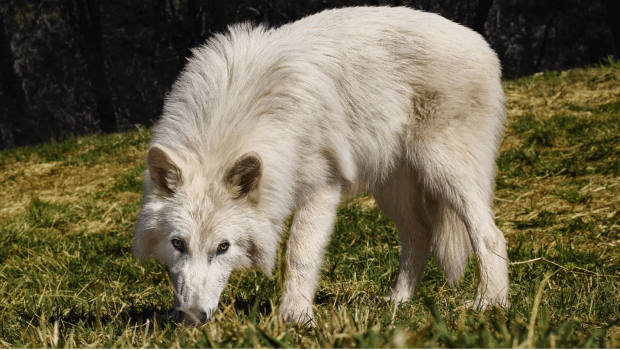
The species is now de-extinct thanks to the work of scientists at Colossal Biosciences. Find out how they successfully did it.
Scientists — and avid Game of Thrones viewers — have known about dire wolves and their extinction for a while. The species became extinct thousands of years ago, but thanks to the work of modern science, they’ve been brought back! The team at Texas-based biotechnology company Colossal Biosciences announced its successful de-extinction of the dire wolf. So, how did they do it? Below, find out.
What Are Dire Wolves?
Dire wolves are canines that lived in the Americas throughout the Late Pleistocene and Early Holocene epochs — between 125,000 to 10,000 years ago. The wolves were typically white in fur color, according to Colossal Biosciences.
How Was the Dire Wolf Brought Back?
According to Colossal’s press release, the company explained how it successfully managed to de-extinct the dire wolf. Scientists:
- Extracted and sequenced ancient DNA from two dire wolf fossils
- Assembled ancient genomes from both and compared those to genomes from living canids, including wolves, jackals, foxes and dholes
- Identified gene variants that were specific to dire wolves
- Determined that dire wolves had a white coat color, and long thick fur
- Performed multiplex gene editing to a donor genome from their closest living relative, the gray wolf
- Screen edited cell lines via whole genome sequencing and karyotyping
- Cloned high quality cell lines using somatic cell nuclear transfer into donor egg cells
- Performed embryo transfer and managed interspecies surrogacy
- Successfully birthed an extinct species
Who Is George Church?
George Church is an esteemed geneticist, molecular engineer, chemist and the co-founder of Colossal Biosciences. He is also a professor at Harvard University, and he founded about 50 biotech companies in his university laboratory. Additionally, Church is listed in 2017’s Time 100, the list of most influential people in the world.
Regarding the de-extinction of dire wolves, Church, according to Colossal’s press release, said, “Preserving, expanding, and testing genetic diversity should be done well before important endangered animal species like the red wolf are lost. Another source of ecosystem variety stems from our new technologies to de-extinct lost genes, including deep ancient DNA sequencing, polyphyletic trait analyses, multiplex germline editing, and cloning. The dire wolf is an early example of this, including the largest number of precise genomic edits in a healthy vertebrate so far. A capability that is growing exponentially.”
Who Is Ben Lamm?
Ben Lamm is the CEO of Colossal. As an accomplished entrepreneur, Ben is a billionaire with a net worth of $3.7 billion, according to Forbes.
While commenting on his company’s de-extinction of dire wolves, Lamm said he “could not be more proud of the team,” according to the April 2025 press release.
“This massive milestone is the first of many coming examples demonstrating that our end-to-end de-extinction technology stack works,” Lamm continued. “Our team took DNA from a 13,000-year-old tooth and a 72,000-year-old skull and made healthy dire wolf puppies. It was once said, ‘any sufficiently advanced technology is indistinguishable from magic.’ Today, our team gets to unveil some of the magic they are working on and its broader impact on conservation.”